National Institute of Polar Research







How the East Antarctic Ice Sheet’s history can tell a relevant story for today and beyond
December 19, 2025
Though ice sheet melting is widely talked of and debated, there is limited knowledge on what happens after the period of melting. Researchers dig into this “after” period and see how it relates to previous patterns.
To understand the present and try to predict the future, the past is a valuable tool. Researchers aim to understand the dynamics of the East Antarctic Ice Sheet in the Lützow-Holmbukta region with the goal of determining if rapid ice sheet thinning (from approximately 9,000 to 6,000 years ago) was followed by stabilization or re-thickening. This information is key to helping predict future responses to ice sheet thinning, as well as to get a clear picture of the current behavior of ice sheet thinning across the Antarctic. With this, future responses to climate change can be improved.
Researchers published results in Scientific Reports on November 17.
“Our findings demonstrate that the East Antarctic Ice Sheet in this region experienced complex mid-Holocene dynamics, with scenarios incorporating modest ice-sheet re-thickening (65-100 m) following rapid thinning providing statistically significant improvement over global deglaciation models,” said Jun’ichi Okuno, researcher and author of the study.
Using the Global Navigation Satellite System (GNSS) and glacial isostatic adjustment modeling (a simulation of the Earth’s response to changes in ice and water mass distribution), researchers used an integrated approach to explore different scenarios. This approach featured models developed using ice-loading history with an incorporated rapid ice-sheet thinning documented in the Skarvsnes area of Lützow-Holmbukta in East Antarctica, along with evidence from previous researchers’ studies.
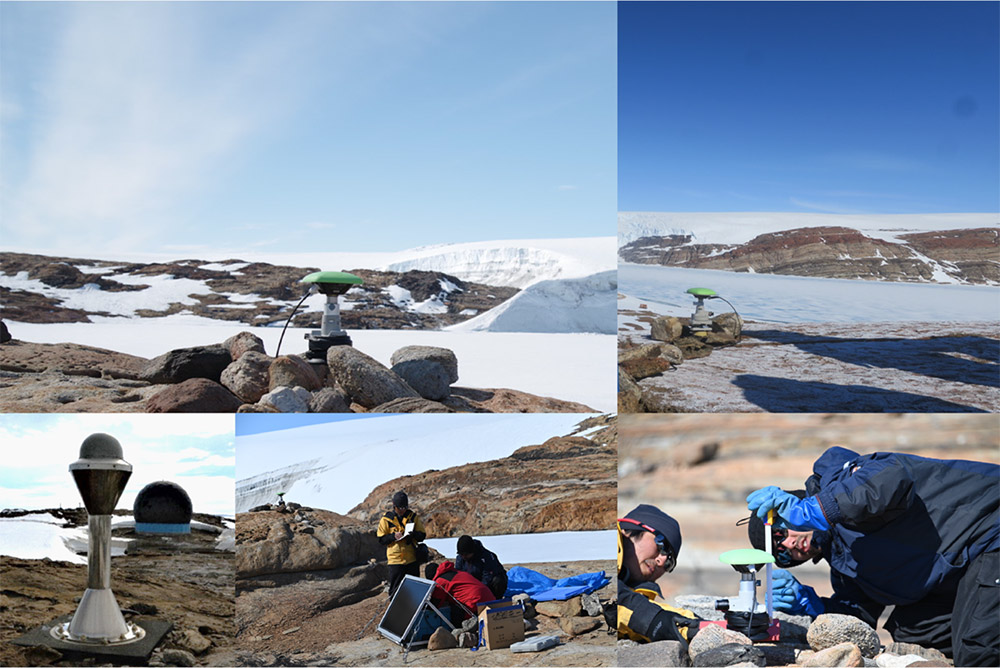
Researchers study ice sheet dynamics in East Antarctica. Research conducted in East Antarctica using glacial isostatic adjustment modeling and Global Navigation Satellite System observations.
Credit: Yuichi Aoyama
This integrated approach allows researchers to better constrain their understanding of past ice-sheet behavior, providing a crucial baseline data for future climate projections.
However, researchers found a significant discrepancy. The glacial isostatic adjustment (GIA) - the Earth’s crustal rebound after ice sheet melting, predicted by previously published global ice models for the last deglaciation, could not explain the crustal movements measured in the Lützow-Holmbukta region.
“This highlights that regional ice-sheet histories can differ markedly from continental-scale trends, and the ice sheet possesses mechanisms for both rapid change and subsequent stabilization, which provides important insights into ice sheet behavior under changing climate conditions,” said Okuno.
While further research is needed to understand the current behavior of the ice sheet, this study highlights the importance of incorporating the knowledge from past dynamics to better understand the ebb and flow of the East Antarctic Ice Sheet.
Beyond ice sheet dynamics, this research yielded valuable insights into the structure of the Earth’s interior. While the study successfully constrained Earth’s interior parameters that align with observed data, the three-layer Earth model used here may have limitations when applied across Antarctica, as the Earth structure parameters derived from the East Antarctic region may not be representative of the entire continent.
However, researchers have ideas for the future of this study, including extending the integrated approach to other East Antarctic regions and lengthening the GNSS time series. The advancements will enhance predictions of the East Antarctic Ice Sheet’s response to ongoing climate change, providing more accurate data for sea-level rise projections and strategies for adapting to the changing climate.
Okuno of the Joint Support-Center for Data Science Research at the Research Organization of Information and Systems with Akihisa Hattori, Koichiro Doi and Yuichi Aoyama of the National Institute of Polar Research and the Graduate University for Advanced Studies, along with Yoichi Fukuda of Kyoto University, contributed to this research. JSPS KAKENHI Grants, the National Institute of Polar Research and the Toray Science Foundation funded this study.
Original Article
Journal: Scientific Reports
Title: Mid Holocene rapid thinning and rethickening of the East Antarctic ice sheet suggested by glacial isostatic adjustment
Authors:Jun’ichi Okuno1,2,3, Akihisa Hattori2,3, Koichiro Doi2,3, Yuichi Aoyama2,3 & Yoichi Fukuda4
1 Joint Support-Center for Data Science Research, Research Organization of Information and Systems, Japan
2 National Institute of Polar Research, Japan.
3 The Graduate University for Advanced Studies, SOKENDAI, Japan.
4 Kyoto University, Japan
DOI: 10.1038/s41598-025-24176-4
URL: https://www.nature.com/articles/s41598-025-24176-4
Funding
This research was supported by JSPS KAKENHI Grants 16K01229, 17H06321, and 21K03685, the National Institute of Polar Research (NIPR) through Project Research No. KP-306, and the Toray Science Foundation.



Research Organization of Information and Systems / National Institute of Informatics / The Institute of Statistical Mathematics / National Institute of Genetics / Joint Support-Center for Data Science Research
Inter-university Research Institute Corporation Research Organization of Information and Systems
National Institute of Polar Research
10-3, Midori-cho, Tachikawa-shi, Tokyo 190-8518, Japan
Copyright © National Institute of Polar Research All rights reserved.