National Institute of Polar Research







Missing geomagnetic reversals in the geomagnetic reversal history
Researchers may have found the ages that hide undiscovered geomagnetic reversals using statistical analysis.
Feb.24, 2026
Several studies have predicted that not all geomagnetic reversals have been discovered, but it was unknown in which periods they might be hidden. The researchers led by the National Institute of Polar Research used a statistical method called adaptive kernel density estimation to model the frequency of geomagnetic reversals at high temporal resolution. Based on the model, they proposed that undiscovered reversals may be hidden in four periods after the Cretaceous Normal Superchron.
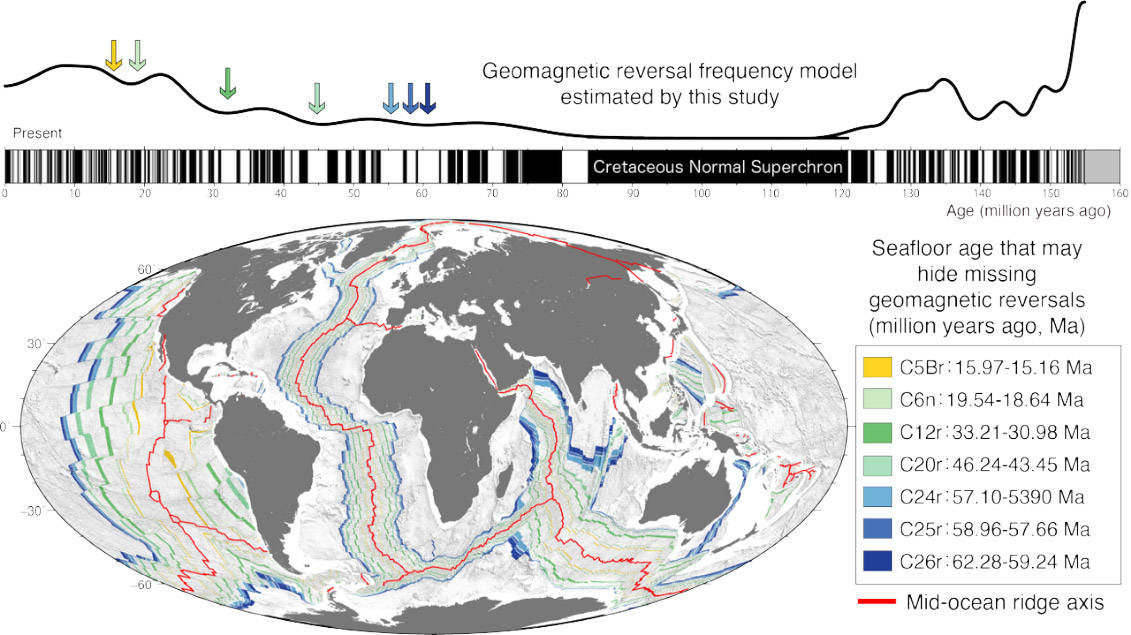
Reversal frequency model and ocean floor structure map.
The detailed geomagnetic reversal frequency model reconstructed in this study, geomagnetic polarity time scale (drawn using data from Ogg, 2020, Geologic Time Scale 2020, Elsevier), and the Earth's ocean floor structure map with ages of missing reversals (drawn using data from Müller et al., 2019, Tectonics). The colored bands indicate the ocean floor at times when high-resolution surveys are needed to detect missing geomagnetic reversals.
In everyday life, we can easily tell whether objects are packed tightly (high density) or spread out sparsely (low density) just by looking at them. But when dealing with time-series event data, scattering along a timeline, it is not as straightforward to objectively identify when the density is high or low. In this situation, a statistical method called kernel density estimation is useful. By assigning a probability to each data point and overlaying these distributions, the method provides a smooth estimate of how event density changes over time. It is particularly effective for analyzing the timing of geomagnetic reversals.
In geophysics, researchers have long-term compiled records of when geomagnetic polarity reversals occurred, and have examined how densely these reversals are distributed over time. It is known that geomagnetic reversals cluster during certain intervals (“dense” periods) and become very rare during others (“sparse” periods). These differences are thought to reflect variations in heat flow across the core–mantle boundary, which influence the geodynamo that generates Earth’s magnetic field.
Periods with high reversal density allow us to more precisely estimate past plate positions, fossil ages, and the timing of environmental changes, using magnetic signatures preserved in the subaerial/submarine rocks or sediments. In contrast, periods with very low reversal density provide fewer dating markers, making reconstructions of the ancient Earth more challenging. However, this scarcity itself can still offer important information, as it may indicate changes in the state of Earth’s interior.
Missing short-time-interval geomagnetic reversals may appear as dips in the new reversal frequency model
Earth’s magnetic field has undergone many polarity reversals, during which the north and south magnetic poles switch places. These events are reconstructed from geological materials such as volcanic rocks, marine sediments, and marine magnetic anomalies, and they are compiled into the Geomagnetic Polarity Time Scale (GPTS). However, some short-time-interval reversals may not appear in the GPTS because they are difficult to observe due to the time resolution limits.
An international research team from Japan (Kyushu University/National Institute of Polar Research/The Graduate University for Advanced Studies, SOKENDAI/The Institute of Statistical Mathematics/Geological Survey of Japan, AIST/Japan Agency for Marine-Earth Science and Technology (JAMSTEC)/Atmosphere and Ocean Research Institute, The University of Tokyo/Kochi University/Institute of GeoHistory, Japan Geochronology Network/Kobe University), the Republic of Korea (Korea Institute of Geoscience and Mineral Resources (KIGAM)/University of Science and Technology), and the United States (Wayne State University) analyzed the latest reversal timing dataset (GPTS2020) to investigate how reversal frequency has changed over time. They applied an adaptive-bandwidth kernel density estimation (AKDE) method, which estimates reversal frequency while accounting for uneven spacing of reversal events.
Previous studies using the AKDE suggested that the frequency of geomagnetic reversals decreased steadily from approximately 155 million years ago toward the onset of the Cretaceous Normal Superchron (approximately 121 to 83 million years ago), and then increased steadily from the end of the superchron to the present (Constable, 2000, https://doi.org/10.1016/S0031-9201(99)00139-9). AKDE can capture broad trends in the density of events in one dimensional time-series data.
Numerical geodynamo simulations show that reversal frequency changes depending on the magnitude and spatial pattern of heat flow across the core-mantle boundary. Mantle convection and true polar wander modify this heat flow gradually over tens to hundreds of millions of years. For this reason, a steadily changing reversal frequency has been considered the most reasonable interpretation. However, the conventional AKDE approach was unable to show when geomagnetic reversals that are missing from the GPTS might have occurred during the past approximately 155 million years.
The researchers applied an AKDE method with improved parameter selection to GPTS2020. This method allowed us to estimate variations in reversal frequency with higher temporal resolution. Specifically, the researchers used a cross-validation method to determine the initial bandwidth, which corresponds to the initial resolution of the analysis. A previous study had chosen this initial bandwidth based on empirical rules, but our approach determines it more stably. As a result, the researchers identified four distinct dips in the new reversal frequency model following the Cretaceous Normal Superchron.
Additionally, when researchers added the newly reported Lima–Limo reversals at approximately 31 million years ago, identified through recent high-precision paleomagnetic and geochronological studies of Ethiopian flood basalts (Ahn et al., 2021, https://doi.org/10.1093/gji/ggaa557; Yoshimura et al., 2023, https://doi.org/10.1029/2022GL102560), and performed the AKDE analysis again, the dip in frequency around approximately 32 million years ago became smoother. This finding supports the interpretation that smoother, long-term variations more closely represent the underlying behavior of the geodynamo. It also indicates that the four periods showing dips in reversal frequency may contain missing reversals.
The researchers conclude that dips in geomagnetic reversal frequency are promising candidates for future investigations aimed at identifying potentially missing reversals. The findings highlight specific time intervals that merit high-resolution paleomagnetic investigation using deep-sea magnetic anomaly surveys, lava sequences, and ocean drilling cores. Additionally, this research contributes to improved understanding of the long-term behavior of Earth’s magnetic field and the dynamics of the deep Earth.
Original Article
Journal: Geophysical Research Letters
Title: Evidence for missing geomagnetic reversals from geomagnetic reversal frequency model using adaptive kernel density estimation
Authors:Yutaka Yoshimura1,2,3, Masakazu Fujii1,4, Hideitsu Hino5,4, Shotaro Akaho5,4, Satoshi Kuriki5,4, Osamu Ishizuka6,7, Toshitsugu Yamazaki2,8, Hyeon-Seon Ahn9,10, Tesfaye Kidane11, Yuhji Yamamoto8, Yo-ichiro Otofuji12,13
1. National Institute of Polar Research, Japan
2. Atmosphere and Ocean Research Institute, The University of Tokyo, Japan
3. Division of Environmental Changes, Faculty of Social and Cultural Studies, Kyushu University, Japan
4. The Graduate University for Advanced Studies, SOKENDAI, Japan
5. The Institute of Statistical Mathematics, Japan
6. Institute of Earthquake and Volcano Geology, Geological Survey of Japan, AIST, Japan
7. Japan Agency for Marine-Earth Science and Technology, Japan
8. Marine Core Research Institute, Kochi University, Japan
9. Quaternary Geological Research Center, Geological Survey Division, Korea Institute of Geoscience and Mineral Resources (KIGAM), Republic of Korea
10. Department of Geological Science, KIGAM school, University of Science and Technology (UST), Republic of Korea
11. Department of Environmental Science and Geology, Wayne State University, USA
12. Institute of GeoHistory, Japan Geochronology Network, Japan
13. Kobe University, Japan
DOI: 10.1029/2025GL120557
Funding
This work was supported by the Data-Scientist-Type Researcher Training Project of The Graduate University for Advanced Studies, SOKENDAI, by JSPS KAKENHI Grants JP22K14124, JP25KJ0258, JP25K01103, JP23K22608, JP23K24909, and JP25K15034, the Basic Research Project of KIGAM (Korea Institute of Geoscience & Mineral Resources) 25-3111-3, "Strategic Research Projects" grant from ROIS (Research Organization of Information and Systems) 2024-SRP-02, and Earthquake Res. Inst., the University of Tokyo, Joint Research program 2024-B-01.



Research Organization of Information and Systems / National Institute of Informatics / The Institute of Statistical Mathematics / National Institute of Genetics / Joint Support-Center for Data Science Research
Inter-university Research Institute Corporation Research Organization of Information and Systems
National Institute of Polar Research
10-3, Midori-cho, Tachikawa-shi, Tokyo 190-8518, Japan
Copyright © National Institute of Polar Research All rights reserved.